

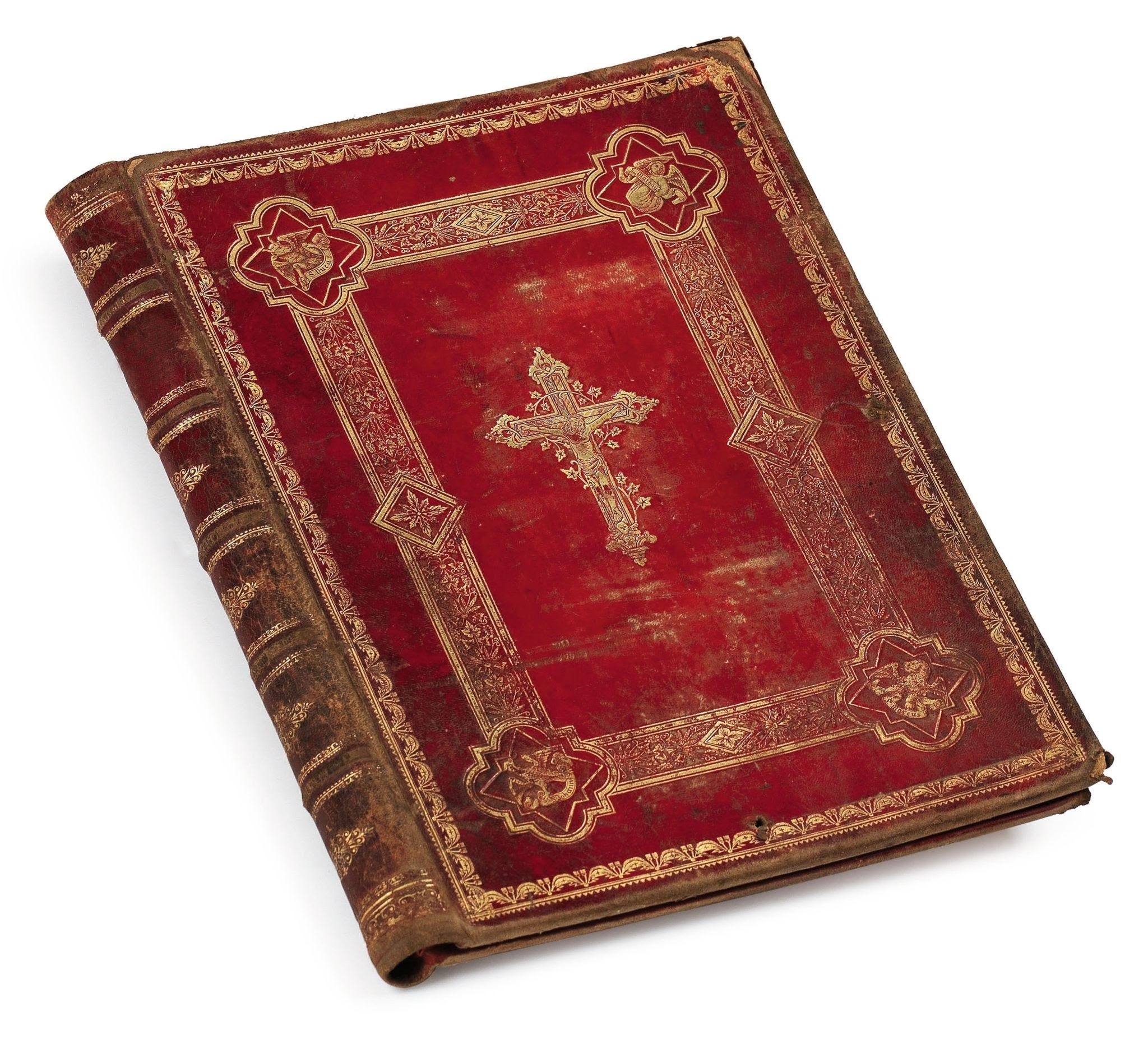
The foundational texts of youth often shape our lifelong views of accountability.. Source: normallens / Getty Images
Many of us Baby Boomers attended Catholic school. In my case, I honestly thought every single city had its own custom catechism. I still own a copy of my Baltimore Catechism. I can recite the Apostles’ Creed entirely from memory today, yet I sometimes struggle to recall the finer points of the three branches of government—a consequence of a fleeting, long-ago lesson on civics.
Growing up, I also assumed there were only two true religions: Catholic and Public. The kids in my neighborhood went to one or the other, and we felt we knew exactly who was eligible to go to heaven and who was fast-tracked for the alternative.
The nuns taught us about the state of our souls by drawing on the chalkboard. The human soul, according to their illustrations, had the distinct shape of a russet potato.
We learned there were two types of sins: venial and mortal.
Venial Sins: These were casually shaded onto the potato soul using the flat side of a piece of chalk.
Mortal Sins: These were violently pounded into the slate with the sharp tip of the chalk, leaving permanent, audible dents on the board.
If we confessed, the venial smudges were easily wiped away. But those sharp, deep mortal sins? They stayed. We were left staring at a baked potato with serious eyes, carrying permanent marks.
A mortal sin had to meet three strict conditions simultaneously: grave matter, full knowledge, and deliberate consent. If all three intersected, it severed your relationship with God entirely, resulting in eternal damnation. The terrifying thought of spending eternity in hell taught us a secular lesson, too: it forced us to recognize, and take absolute responsibility for, deeply destructive behavior. Sometimes, this moral boundary coincided with breaking human law.
What Were the “Publics” Learning?
So, what were the kids at the public schools being taught while we were focused on the Baltimore Catechism? Without spending a third of their day on religious doctrine, they adhered to a remarkably similar structural curriculum.
Schools in the 1950’s maintained a strict curriculum and rigid teaching methods, leaving little room for deviation. The focus remained squarely on traditional subjects like math, science, and literature, heavily driven by lectures and rote memorization.
Civics was once a foundational pillar of that traditional curriculum. However, it experienced a steep decline starting in the 1960’s. Decades later, it was further marginalized by the 2001 No Child Left Behind Act, which aggressively shifted public school focus and funding toward standardized testing in reading and math.
Today, education remains entirely decentralized. There are no mandatory federal standards for civics education. State requirements vary wildly; roughly 39 states require at least one basic course in government or civics, while the rest rely on loosely integrating it into broader U.S. History classes.
The Ultimate Constitutional Crisis
A proper civics education is supposed to teach us a fundamental truth: the U.S. federal government is divided into three co-equal branches to ensure a strict separation of powers.
Legislative Branch: Makes the laws (Congress, consisting of the Senate and the House of Representatives).
Executive Branch: Enforces the laws (Led by the President, the Vice President, and the Cabinet).
Judicial Branch: Interprets the laws (The Supreme Court and lower federal courts).
But what happens when one branch simply ignores the checks and balances enshrined in our Constitution? Specifically, if the judiciary issues a definitive ruling and the executive branch flatly refuses to obey it, what levers are left to pull? This is exactly what the Trump Administration does.
Writing in the Federalist Papers, Alexander Hamilton described the judiciary as the weakest of the three departments of power:
“The judiciary... may truly be said to have neither FORCE nor WILL, but merely judgment; and must ultimately depend upon the aid of the executive arm even for the efficacy of its judgments.”
When the executive branch chooses to ignore the judiciary, it triggers an immediate constitutional crisis. Courts have no standing army, no police force, and no enforcement power of their own. They rely entirely on the integrity of executive agencies—like the U.S. Marshals or the Department of Justice—to back up their legal judgments.
When that integrity vanishes, the system fractures.
The Modern “Mortal Sins” of Society
There is a gnawing, pervasive feeling across America and the West that a self-serving elite has completely corrupted the rules of society to favor themselves. Landmark events, like the partial unsealing of the Epstein files, have pulled back the curtain on the hidden networks the powerful use to advance their own interests and evade legal accountability.
Pundits spend an immense amount of energy pitting political parties against each other. Yet, the data shows that the margins are overwhelming among Democrats, Republicans, and Independents alike when it comes to a foundational truth: corruption is the heart of political evil.
It shouldn’t be a partisan competition. Our collective democracy is tilting. Citizens United and subsequent judicial rulings over the last two decades have heavily weighted the scales in favor of mega-donors over everyday voters.
Americans broadly agree that systemic corruption has the power to drive our democracy off a cliff, and we know that voting is our primary mechanism to effect change. Yet, a telling indicator of our national morale is that only 39% of us currently say voting in elections is “very effective” at changing the country for the better. Activities like protesting, attending rallies, or volunteering for campaigns are viewed as even less impactful.
Is Freedom a Right, or a Responsibility?
“We the People” is a phrase of mutual dependence. It means my individual freedom is inherently tied to your freedom. If liberty for one group is systematically restricted or removed, it jeopardizes the entire democratic framework we all rely on. Living in a free society means we are charged with actively protecting freedom for one another through our shared civic responsibilities.
The sheer breadth of modern public unhappiness suggests a deep, underlying moral critique. Even now, amid wrenching technological change and evaporating institutional standards, regular people remain focused on a core desire for personal and leadership responsibility.
We are missing a collective sense of consequences. We are missing the chalkboard.
I want to close with a thought from my Canadian Substack colleague, Trish Findlay, who loves to dig into the definitions of interesting, theatrical words like Scaramouche—the stock comedic character of a roguish, unscrupulous clown. She summarized our current geopolitical theater perfectly:
“One cannot help but draw the conclusion that the most evident Scaramouche is making the world dance the fandango while he carries the nuclear codes, and no one is laughing.”
.
Poll results are by percentage of votes and do not disclose the identity of voters. You are also encouraged to use the comment sections and engage in a conversation. I promise eternal damnation is not at risk.
As a registered independent I get BS literature from both sides! At least I can read the information the democrats send. I really think the Republicans live in another part of the galaxy.
It's clear that most Americans did not receive, or at least retain, a strong Civics education. As someone famously, and grossly stated, "I love the poorly educated"...