

Anna Jarvis around 1909. Image courtesy of the Library of Congress.
“You have the most important job there is in America or any place else... I just want to wish you all a very happy Mother’s Day.” — President Donald J. Trump, Mother’s Day 2026
The Origin of the Day
It’s always nice when the President of the United States emphasizes the importance of mothers; without them, none of us would exist. Yet, if only mothers could be compensated for this “most important job.” While brunch and flowers are lovely, they often obscure the true origin of Mother’s Day. It was meant to be more than a Hallmark moment.
The Mother’s Day origin story has gained prominence this year. When founded by Julia Ward Howe, greeting cards were not on the agenda. She agreed with the sentiment that mothers shape the world, famously stating:
“I earnestly ask that a general congress of women, without limit of nationality, may be appointed… to promote the alliance of the different nationalities, the amicable settlement of international questions, the great and general interests of peace.”
Later, Anna Jarvis established the national holiday to honor her own mother, who birthed more than twelve children. She chose the second Sunday in May—the anniversary of her mother’s death. Eventually, President Wilson issued the first national proclamation in 1914, just before the world descended into the Great War.
Tradition and Memory
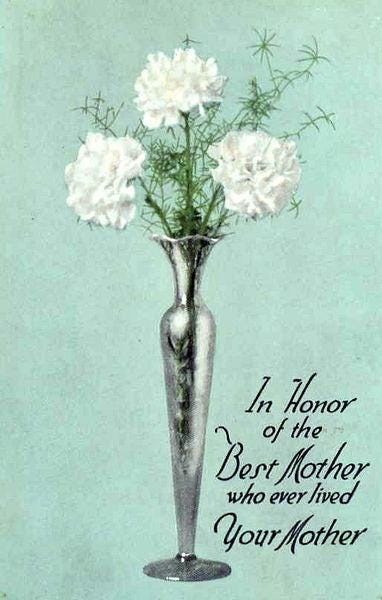
Mother’s Day can be bittersweet for women whose children have died and for daughters who have buried their mothers. Anna Jarvis chose white carnations to celebrate her mother’s memory. My own mother made corsages, choosing a specific color for each: her corsage was white because her mother had passed, while my sister and I wore pink or red. In church yesterday, all the women received yellow carnations—symbolic of friendship and new beginnings.
Beyond the Binary
During coffee hour, the conversation turned to single mothers who act as both mother and father daily. Kudos go to the noncustodial parents who play an active role, yet we must acknowledge the fathers who are absent even when physically present—and, in all fairness, the mothers who are less available.
The good news is that the existence of the Divine Feminine suggests that complementary energies exist within every being. As Emily McGowan notes, we must move beyond a morality judged solely on the “sins” of one lady who once gave a guy an apple. Single parents are innately endowed with the balanced energies needed to raise children. I recommend reading Emily McGowan’s complete article.
The Goal is Enlightenment
Between Sunday’s sermon and a presentation on coping skills for our current political climate, a theme emerged: we spend so much energy trying to convince “the other side” they are wrong that we lose sight of what we actually stand for. But when is the other side “dead wrong?”
As Proverbs 28:13 says: “A person who refuses to admit his mistakes can never be successful. But if that person confesses and forsakes those mistakes, another chance is given.”
“There is nothing wrong with making mistakes, but one should always make new ones. Repeating mistakes is a hallmark of dim consciousness.” — Dave Sim
I admit when I make a mistake. When confronting a nemesis, I find it more powerful to say: “I must have made a mistake.” Being right is not my goal. Enlightenment is.
Language and the Goddess Within
Language evolved to specify gender, but it is generally agreed that the word “God” derives from a Proto-Indo-European neuter passive perfect participle. I once attended a retreat co-led by Joan Borysenko on the importance of the goddess within us. She began with the original Aramaic of the Lord’s Prayer:
Abwoon d’bwashmaya (O Birther! Father-Mother of the Cosmos)
The word Abba (father) replaced Abwoon when scholars reasoned Jesus was praying to a paternal figure, but the original version was non-binary. Gender identification is not a “new thing.” That retreat was mystical; in guided meditation, I saw the trail of mothers stretching back through my grandmothers to Mitochondrial Eve. It was a deeply grounding experience.
Before Eve: Power and Balance
Nemesis, in Greek mythology, was the goddess of divine retribution. She was feared as the deity who delivered justice against hubris—the sin of excessive pride.
When we recognize the Divine Feminine within every person and move beyond gender wars, we become less divisive. Our world today requires the goddess within all of us to rise up and assert our right to be both feared and respected. To claim that power, we must find balance:
Balance Fear and Respect: The most effective power uses both.
Demonstrate Competence: Respect requires proof of capability.
Set Clear Boundaries: Consequences keep systems in line.
Be Fair, Not Cruel: Unjust punishment only breeds hatred.
Prioritize Truth: Respect collapses without honesty.
Adapt to Context: In crises, lean on strength; in stability, lean on respect.
I would love to read your thoughts about this in the comments below.
I have a bumper sticker on my car. It reads GOD, THE ORIGINAL THEY/THEM.
To me Jean “God, the original they/them” connotes that there are others? God the Father is Omnipotent. No gender. His (son took a human form), died for our sin, went back up to Heaven to sit at the Right hand of God. Then God the Father sent the Holy Spirit to dwell in each and every one of us forever.
I am not disparaging the LGBGT community. I only remarked respectfully to you when I saw the reference to God. DL 😊