
The Cost of Making History: A Perspective on the Women’s Movement
My story

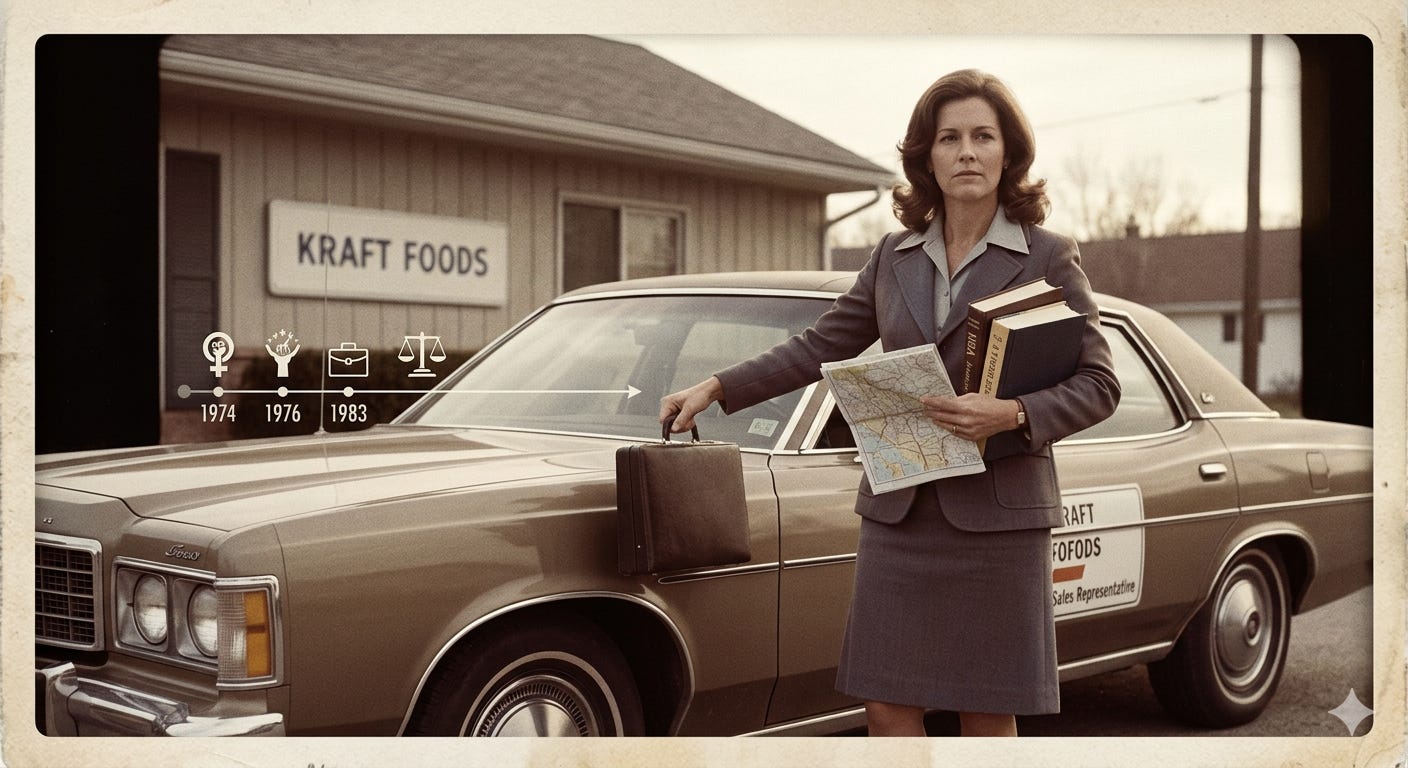
AI Generated Image
In 1983, at the “ripe old age” of thirty-three, a high school student asked me for a historical perspective on the women’s movement for her class paper. It was one of those moments where you wonder if you should accept the “compliment” of being a historical resource. We’ve all been there.
At the time, I was working for the newly established Non-traditional Student Center at the University of New Hampshire. I was a “non-traditional” woman in every sense: one of the very few women to ever complete the UNH Evening MBA program.
Following Directions as a Radical Act
Our capstone course required teams to write an original case study on an existing business—this was 1976, long before the Internet made research a click away. When our papers were returned, the professor announced that those who received an “A” could leave.
Judy and I (two women, same name) stood up. The room full of men stared. Our “secret” to success? We simply followed the directions. The men were given the option to rewrite their papers for a grade change; we just walked out.
“Pretty Good for a Girl”
In 1974, I became the first female Sales Representative for Kraft Foods in New Hampshire, Maine, Vermont and North East Massachusetts. Another female Sales Rep covered Boston. My territory required driving a company car 1,000 miles a week with nothing but a paper road map.
While Kraft eventually picked up 80% of my MBA tuition, my entry into the program was thanks to a loophole. My previous employer, Davidson Rubber Co., had a benefit for “clerks” to take courses. They never expected a clerk to be admitted to an MBA program. Because the rules weren’t explicit, I opened the door for women there to be reimbursed for college and graduate-level work. I made history by accident of ambition.
Making history comes with a cost. In the 1970’s, filing an EEOC (Equal Employment Opportunity Commission) complaint was professional suicide. It was hard to prove discrimination because, after all, “men were just being men.”
When Kraft hired me, my boss was on vacation. He was furious that a “girl” had been hired over his head and spent his time trying to force me out. He made two fatal mistakes: he was “in bed” with a warehouse he forbade me from selling to, and he forced me to drive an unsafe company car serviced by his “buddy” mechanic. I quit over the car, but our District Manager intervened. My boss “retired” early, and my fellow Kraft Sales Reps supported me especially when our incompetent boss was gone.
The Personal Toll
The biggest cost of my career and my MBA was my marriage. My husband, a Vietnam Veteran with two Purple Hearts, was suffering from “Post-Vietnam Syndrome.” We divorced, though four years later he reached out to apologize and acknowledge the struggle he was going through. Yes, he encouraged me to take the sales job and get my MBA but he did not think I would succeed.
By the 1980’s, I had transitioned into academia, teaching courses like Men and Women in Management. For those looking to understand that era, I highly recommend:
Of Woman Born: Motherhood as Experience and Institution by Adrienne Rich
A Tale of “O”: On Being Different in an Organization by Rosabeth Moss Kanter
The Legal Hurdles: Credit, Property, and Names
The rule of law is holding up—for now. But in 1972, the hurdles were constant. When my husband and I looked to buy our first home, mortgage lenders commonly discounted a wife’s income by 50% to 100%. Mine was discounted by 60%.
After my divorce, the “system” fought back:
Credit: I tried to remove my ex-husband’s name from a department store card I had opened with my own salary. I was told I couldn’t—he “held” the account because I was the wife. He got my credit score.
Property: We were able to sell our first house at a profit and buy a better one. When we divorced, we agreed to split the down payment and I could keep the house. My lawyer created a quit-claim deed that gave my ex-husband half the house’s down payment upon sale or my death. I chose to refinance to pay him immediately. The mortgage officer tried to talk me out of it. As he filled in the application he was shocked by my salary, I said “pretty good for a girl.” He recovered and said, “Pretty good for any one in Rochester, NH.”
Identity: It cost me $75 to legally return to my maiden name. Even then, the bureaucracy struggled. My first Kraft mail stamp said Judith Fabalauskas. I called David and told him my name started with an “S.” The second said Sudith Fabalauskas. He finally got it right but Social Security typed Hudith instead of Judith. (Keyboard slip)
Use Your Vote or Lose It
My parents taught me that voting is a personal choice, even if you “cancel out” your spouse’s vote. Today, women must be vigilant about name changes and registration. If the SAVE Act (H.R. 8281) passes, millions of married women who have changed their names may find their birth certificates insufficient to prove citizenship for voting.
My voter registration matches my birth certificate, passport, and Real ID. Ensure yours does too.
The stakes in the 2026 primaries are crucial. Each vote matters.
Democracy versus autocracy is more than just an abstract conflict between competing principles. When our nation shifts toward authoritarianism, it affects all of us. Quite literally, our lives, liberty, and pursuit of happiness are at stake.
Please fact check and follow more than one news source.
Let’s have a conversation and not an argument. Have some fun with this.
How many of you remember this ad?
Do you think women have come a long way since 1968 when it aired?
When women are called “girls” in 2026, should men be called “boys”?
Is “Woman” a dirty word or something?

Timeline of Legal History of Women in the United States
[!NOTE]
The following is an abbreviated list of laws affecting women in America. You can click the link for the complete list. Next week, I will cover women’s progress as lawyers and politicians.
1769: American colonies adopt English common law: “The very being and legal existence of the woman is suspended during marriage.”
1866: The 14th Amendment defines “citizens” and “voters” specifically as male for the first time.
1873: The Supreme Court rules a state can exclude married women from practicing law.
1920: The 19th Amendment is ratified: The right to vote shall not be denied on account of sex.
1938: Fair Labor Standards Act establishes a minimum wage regardless of sex.
1964: Title VII of the Civil Rights Act prohibits employment discrimination.
1974: Housing and credit discrimination against women are finally outlawed by Congress.
1981: Kirchberg v. Feenstra overturns laws designating a husband as “head and master” of joint property.
2022: The Supreme Court overrules Roe v. Wade, returning abortion regulation to the states.
Boy you wrote a mouthful Judiff. Yes women were chattel. My very vivid memory of you from the early 70’s was that you were an amazing problem solver. You made your own roads. Your humor was necessary at the time. No quick fixes here re Government. I am a right down the middle chick. EGO MEANS “EDGING GOD “OUT”. All I can do is spread love and jump in as needed if I see someone hurting a child or animal. Donna🙂