

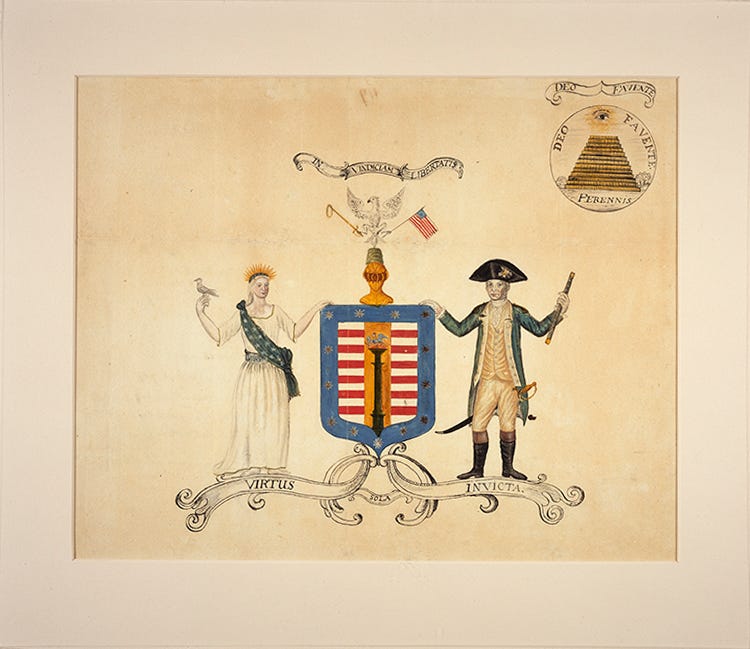
Design for the Great Seal of the United States, 1782 (obverse)
Constitutional law is a mandatory class taught during every law student’s first or second year, and it is heavily tested on the bar exam.
To be completely honest, I would have failed Constitutional Law.
My eyes glazed over when my kids tried to teach me to play Catan. The objective is simple enough: reach 10 victory points by building roads, settlements, and cities through rolling dice, trading, and building. But all I remember is shouting, “I don’t want your sheep!”
Now, since I love trains, learning Ticket to Ride was a piece of cake. And as it turns out, board games and national governance aren’t all that different:
“Rules are an integral part of games, and they serve a variety of purposes. One of the main purposes of rules is to establish a level playing field for all players. By defining the parameters of the game, rules help to ensure that everyone is playing by the same set of rules and that no one has an unfair advantage.” — Michael Filimowicz
The Constitution is simply the rule book for governing in America.
CORE CONSTITUTIONAL TOPICS:
• Federalism: The balance of power between the federal government and individual states.
• Separation of Powers: Division of authority among legislative, executive, and judicial branches.
• Individual Rights: Protections under the Due Process and Equal Protection clauses.
• Judicial Review: The power of courts to check government actions.
As the National Archives reminds us, the Constitution contains a preamble and seven articles establishing how the government operates and creating a system of checks and balances so no single branch becomes dominant. Executive and judicial officers all take an oath or affirmation to support this rule book.
The Teams Playing the Game
Games can be played as individuals or in teams. If politics in America is a game, we certainly have no shortage of team names.
Here are America’s Favorite Team Names, in alphabetical order:
Anti-Masonic
Communist
Constitutionalist
Democrat
Democratic-Republican
Fascist
Free Soil
Green
Know Nothing
Libertarian
Populist / Progressive
Republican
Socialist
Whig
Following James Madison’s advice, Americans today can refuse to be misled into describing the U.S. in a single, inadequate term or team.
Instead, we might prize two historic commitments at once: to a republic that insists on the people’s right to be represented rather than ruled, and to a democracy that ensures ordinary people might collectively make it so.
A Proposal for the White House Lawn
“In a world where there are so many forces trying to tear us apart, sport has the power to unite. Watching fans from around the world embrace America, and Americans embrace different cultures, has been inspiring.” — Matthew Robinson, Professor of Sport Management
So, I have an idea.
America’s favorite political teams should hold a Soccer Match.
Each team would contribute an entry fee. The White House Lawn could be turned into a full soccer pitch. And all proceeds would be applied directly toward balancing the federal budget.
You would not be the first person to call me crazy, but I hope you at least chuckled at my plan.
As Benjamin Franklin famously noted, “In this world nothing can be said to be certain, except death and taxes.” But perhaps we can add political absurdities to that list.
From the Sublime to the Ridiculous
250 years ago, Thomas Paine published a modest pamphlet called Common Sense, galvanizing colonists to seek independence. He enlisted in the Continental Army in 1776, served as an aide to General Nathanael Greene, and authored The American Crisis essays—opening with the immortal words, “These are the times that try men’s souls.” His writings provided the philosophical bedrock for the Declaration of Independence.
Decades later, in 1994, attorney Philip K. Howard published The Death of Common Sense: How Law is Suffocating America, analyzing the excesses and deficiencies of modern regulatory law and bureaucracy.
It brings to mind a concept popularized by both Napoleon Bonaparte and Thomas Paine: “From the sublime to the ridiculous.” It implies that a very noble or serious thing is often only a tiny step away from a silly or funny one.
Which brings me to my final sharing—Eleanor Roosevelt’s Nightly Prayer:
“...forbid us to be satisfied with what we make of life.
Draw us from base content, and set our eyes on far-off goals. Keep us at tasks too hard for us that we may be driven to thee for strength. Deliver us from fretfulness and self-pitying; make us sure of the good we cannot see and the hidden good in the world.
Open our eyes to simple beauty all around us and our hearts to the loveliness men hide because we do not try to understand them. Save us from ourselves and show us a vision of a world made new. May the spirit of peace and illumination so enlighten our minds that all life shall glow with new meaning and new purpose...”
Whether a prayer like this is sublime or ridiculous depends entirely on one’s perspective. Believers view it as a sublime connection with the divine, while critics might see it as a futile exercise.
In a world governed by complex rules, competing teams, and endless games, perhaps our best move is simply choosing to look for the hidden good in one another.

Tell me what you think in the comment section. It can be sublime or ridiculous. Lets play a game without rules and lighten up.
The rules of today's politics are "kill or be killed." Soccer meets Hunger Games. Oh for the days, when it was a little less vicious--perhaps like dodge ball.
Absolutely Judiff! I Gota’ get down to your Lithuanian dance. Some day 🥂🤍