

The current debate on censorship in the US—from book bans, social media blocks by public officials, and "divisive concepts" legislation—strikes a deeply personal chord with me. My historical novel, Ona’s Tears, which I began writing after I retired in 2012, was never intended to be a cautionary tale for modern America. Yet, the echoes of history are impossible to ignore.
To write this book, I had to immerse myself in extensive research on Russian history, understanding what life was like in Lithuania between 1905 and 1918. The narrative is built on stories my grandparents were too afraid to tell, about book bans, forced conscription into the Russian Army, and the ever-present fear of being deemed an "enemy of the Tsar." These stories feel uncomfortably present today. In this country, we also see a growing list of “enemies,” free speech is being challenged, and for many, the sense of living in fear is palpable.
My second novel will cover the period from 1918 to 1945 focusing on my parent’s lives as first generation Americans. The third will be about my grandmother's sister’s family who stayed behind.
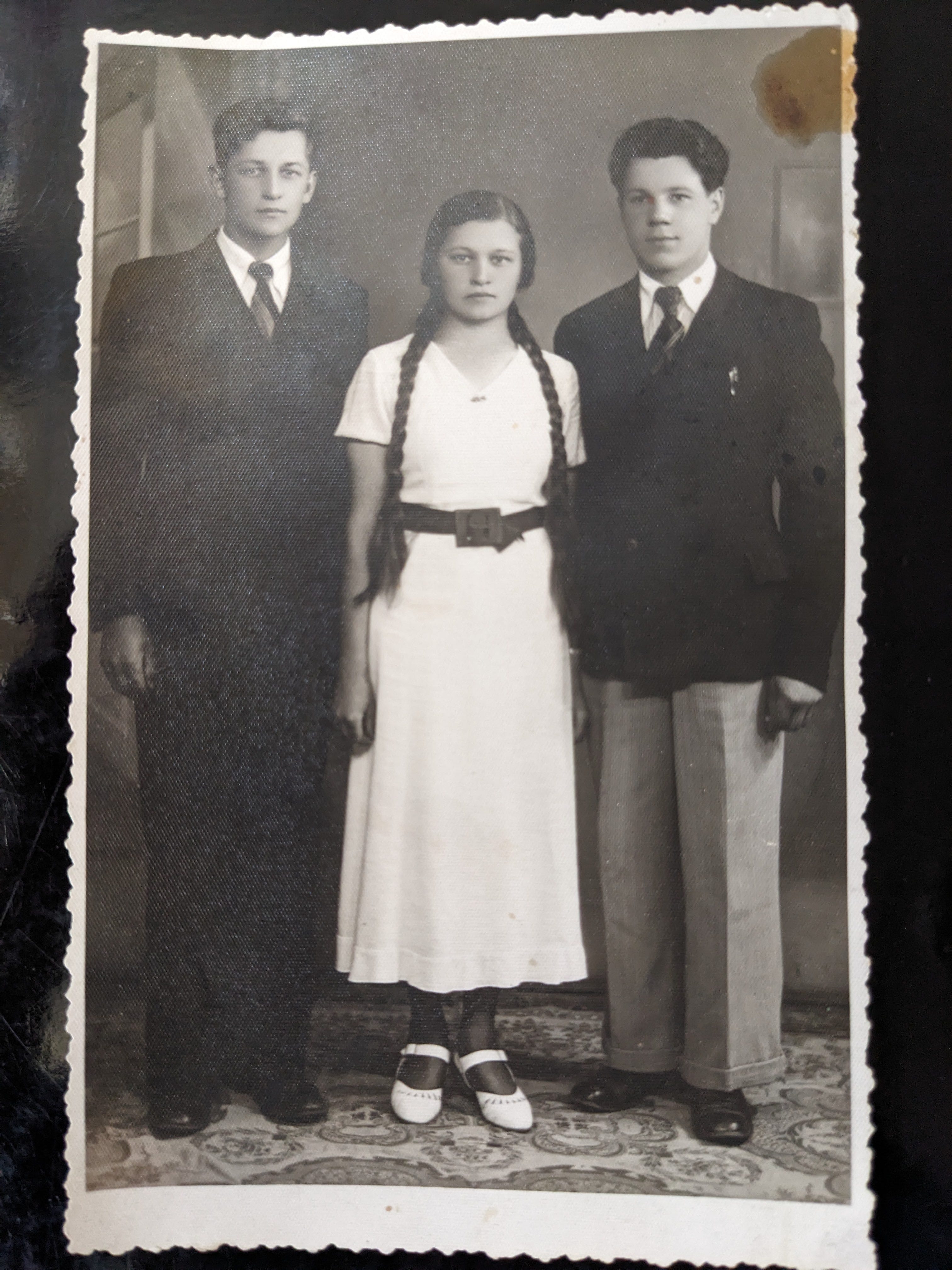
Both of my mother’s cousins (on the left) were sent to Siberia or labor camps. In June 1941, nearly 40,000 people from the Baltic States were deported to the Soviet Far East.
In 1946, her female cousin was sent to Siberia with her husband (on the right) and daughter. In 1954 she wrote that she had just returned from "the other republic," her daughter was released in 1951 and her husband "died in the war," a common euphemism for a Siberian labor camp. Her male cousin was torn from his wife and two young children. In one letter from 1966 , he wrote that he had been in "the hospital" for 11 years, which was another code for Gulag. Their letters were carefully worded to evade Soviet censors.
My first introduction to the Gulag was at Hood College, where my Professor Leonard Latkovski assigned Aleksandr Solzhenitsyn's One Day in the Life of Ivan Denisovich. I was so moved by the simplicity of the writing and the resilience of the human spirit that I read every book Solzhenitsyn wrote. He became a powerful role model and spoke directly to the Lithuanian roots that run deep in my soul. These roots not only inspired me to write my first book but also raised my awareness of the rise of fascism today.
In 2012, I took a Social Psychology course, hoping to explore my premise that America was "asleep at the wheel" and influenced to fuel the economy. For example, people were led to desire bigger cars based on the false belief that "if bigger is safer, even bigger must be safer still." This notion is flawed, as larger vehicles offer minimal safety benefits while posing substantial dangers to others.
This mindset of "bigger is better" at any cost, without considering the collective impact, is evident in other areas of our society, particularly in our justice system. It's no surprise that mass incarceration is an engine of economic injustice. The American Gulag is a real concept, with a system of mass incarceration that is a big business operated by corporate prison companies.
Any student of business understands the power of economics and how money rules. A psychology student, on the other hand, understands that greed is not inherently a bad word; it is simply a human drive. The challenge lies in redefining wealth and what truly makes us happy. We have the power to redefine our values.
So, dear readers, I invite you to wake up and truly think about what is good for you personally and, more importantly, what is good for the world. There is no single right answer. The power of the debate requires more than one perspective. The goal is not to win the debate but to reach a mutually acceptable agreement on the problem. As my college yearbook quote by Charles M. Schulz states, "It doesn't matter what you believe, as long as you are sincere." This was true in 1972, and it holds even more truth today.