

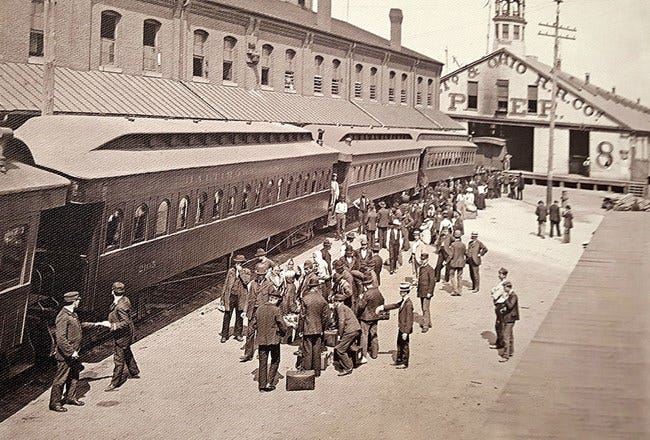
Baltimore Immigration Museum
I am not a formal student of history, but I know this much: America was built by immigrants who displaced indigenous people. There is hardly a country in the world that can claim a different past. Tribes became empires; empires fell and became countries; countries sent explorers to find new lands. Even today, nations fight to assimilate and conquer. We feel as though we are constantly on the verge of World War III, or about to be overcome by the next pandemic. (I am binge watching and recommend The Last Ship on Netflix. It’s patriotism on steroids!)
As someone who reads and writes historical fiction, history is always top of mind for me. I just finished Min Jin Lee’s Pachinko, which beautifully covers six generations of Korean history from 1910 to 1989.
As I write my second book—set between 1918 and 1930—I find myself constantly uncovering immigrant history and the vital role immigrants played in surviving the Great War, Spanish Flu and the Great Depression. In today’s political climate, there is a loud push to rewrite history. It feels as though some of us simply don’t want to face what it actually takes to build a nation.
As a second-generation immigrant, I was surprised to hear the grand declaration that “America is back.” It reminds me of when people ask if I have “found Jesus”—I never knew he was lost?
Worse, I recently heard the words: “Send them into exile. We need to make space for the people who support me.” Those are the classic words of a fascist, yet they were uttered by an American.
The July 4th Washout
Living in Baltimore, just 30 miles from Washington, D.C., we spent this 4th of July trapped under a oppressive heat dome paired with severe thunderstorm warnings. Mother Nature canceled parades, postponed fireworks, and put a definitive damper on family cookouts. What is a country to do when its birthday plans are ruined and Madison Square Garden is already rented out?
Since I am descended from the last pagans, I decided to look into Lithuanian gods and goddesses to see if any of them would wish bad weather on an occasion like this. It turns out they weren’t into revenge; they were into reverence. They seemed far more benevolent than many humans today.
Unfortunately, our current weather reality isn’t looking much better. Rain dates are already scheduled to be rained out, and oppressive heat has become a worldwide event. Heat domes can kill. As Fox Weather reported:
“The massive heat dome that set up shop over the eastern half of the country is finally starting to weaken, but not before it packed a punch and killed nearly two dozen people... Extreme heat gripped hundreds of millions of Americans starting Tuesday and lasting through the July 4th holiday weekend.”
According to meteorological organizations like the Copernicus Climate Change Service, the sobering scientific consensus is that 2023 may have been the coolest summer for the rest of our lives.
We can’t wait for better weather to celebrate America’s 250th birthday—or can we? It turns out we can. We can take a whole year to mark the semiquincentennial of the Declaration of Independence.
Dueling Speeches & Divided Realities
The heat dome kept me trapped inside on the 4th. I spent the day finishing my book, completing five online jigsaw puzzles, and listening to competing political speeches. A few core definitions kept swirling through my mind as I watched the programming:
The Constitution: A system that limits power to prevent tyranny through checks and balances, protects individual rights from government overreach, and stands as the supreme law of the land.
Capitalism: An economic system driven by private ownership, where investments, prices, and production are determined primarily by free-market competition.
Conflict of Interest: A direct clash between a person’s private interests and their official responsibilities in a position of trust.
As I listened to our political leaders speak, I noticed a stark divide in how America’s upcoming 250th birthday is being handled. It perfectly mirrors the tension between public service and private interest.
America 250
Origins: Established by Congress in 2016 (a bipartisan initiative signed by President Obama) to coordinate educational initiatives and public programs.
Events: Focuses on grassroots and nationwide celebrations, including neighborhood block parties and historical exhibits.
Funding: Supported by federal dollars allocated by Congress and private nonprofit donations.
Oversight: Required to submit annual spending and funding reports directly to Congress.
Freedom 250
Origins: Created via executive order by President Trump to establish the “White House Task Force on Celebrating America’s 250th Birthday”.
Events: Manages landmark, administration-led events on the National Mall, such as the 16-day Great American State Fair, fireworks, and White House-connected sports showcases (like UFC matches).
Funding: Operates primarily as an external public-private partnership, raising money via private donations and leveraging federal event grants.
Oversight: Contained entirely within the executive branch, meaning it operates without direct congressional oversight.
The program included the new Air Force One, a $400 million aircraft generously gifted to the United States by the Qatari government.
The contrast became even clearer in the speeches themselves. Consider the different lenses through which our leaders view the nation right now:
Donald Trump:
“After 250 years, unlike so many others in the world, in this country we have freedom of speech, freedom of religion, equal justice under the law — although I wasn’t treated that well, but we won’t get into that... And the right to keep and bear arms...”
Bill Clinton:
“With the help of lifetime appointees to the Supreme Court and a compliant Congress, they [Republicans] have weaponized government to settle personal scores, prosecute enemies, stamp out free speech, and made the federal government a new profit center for themselves and their allies.”
JD Vance:
“Reject the view of your nation that sees only its sins, but not its grace and its greatness. Everything that we have done... we have done together, not as citizens against each other, but as a common people working toward a common future.”
Josh Shapiro:
“...What we’ve got to focus on — not just as a party but in politics in general — are real deliverables for people on getting stuff done for people and shying away from this performative politics that just makes noise but doesn’t make anybody’s life better.”
Realism vs. Pessimism: Why I Fly My Flag
As we celebrate American independence, many of us lull ourselves into believing we are completely safe. We aren’t.
People sometimes ask why this second-generation Lithuanian flies a Ukrainian flag off her front porch. It’s not because I don’t believe in America. It’s because I feel the “pain of blood.” It is written directly into my DNA.
In her piece, What Ukraine Means for Lithuanians Haunted by Soviet Past Inga Rudzinskaite-Colman writes:
“The deportations of Ukrainians to Russia make me think of the cattle trains that took an estimated quarter of a million Lithuanians in the 1940s to the frozen wastelands and gulags in Siberia. Tens of thousands perished along the way. More than 30 years after the fall of the Soviet Union, Ukrainians are fighting for their very right to exist. Our part of Europe understands the stakes, and we know exactly who the enemy is. Ukrainians are fighting for our future, too.”
My mother’s two cousins were among those tens of thousands who were sent to Siberia.
The Future is in Our Hands
Substack readers generally know what is at stake and how vital it is to vote. Yet, despite record turnouts in recent years, 80 million Americans still do not vote.
When surveyed, their reasons are revealing:
29% are not registered to vote
23% are simply not interested in politics
20% do not like any of the candidates
16% feel their vote won’t make a difference
10% remain completely undecided
What every single one of us can do right now is engage in conversations—not by telling people who to vote for, but by talking about why it matters. We can be real-world examples of what it looks like to realize that the right to vote is something that can actually be lost. Become familiar with the Safeguard American Voter Eligibility Act, especially if you are a woman who changed your name.
What about you? Do you view voting as a fundamental right, or a civic obligation? I would love to hear your thoughts in the comments below so we can discuss how to protect this country we love.
Exercising your legal right to vote if you are a citizen of the USA is both a fundamental right and a civic responsibility. As a registered Independent, I am among the 20% who usually does not like any of the candidates; and as a former resident of a blue state, I represent the 16% who know (do not just feel, but know) that my vote won't make a difference in national or state elections. But, I show up and vote anyway.
I am now a resident of NH and reside in a purple voting district. I am hopeful my vote will matter and my choices will have significance. The fact that the geography of where you live and vote determines the outcomes of elections as the country becomes increasingly polarized, is a disturbing issue.
Wanted: non-partisan candidates! Josh Shapiro said it well.
Revenge, reverence
for planet, people, peace, life.
Our vote shows our choice.